Note
Go to the end to download the full example code.
Plotting features on a 3-D surface
In addition to draping a dataset (grid or image) on top of a topographic surface,
you may want to add additional features like coastlines, symbols, and text
annotations. This tutorial shows how to use pygmt.Figure.coast,
pygmt.Figure.plot3d, and pygmt.Figure.text to add these features
on a 3-D surface created by pygmt.Figure.grdview.
This tutorial builds a 3-D map with additional features in four steps:
Creating a 3-D surface
Adding coastlines on a 3-D surface
Adding symbols on a 3-D surface
Adding text annotations on a 3-D surface
import pandas as pd
import pygmt
1. Creating a 3-D surface
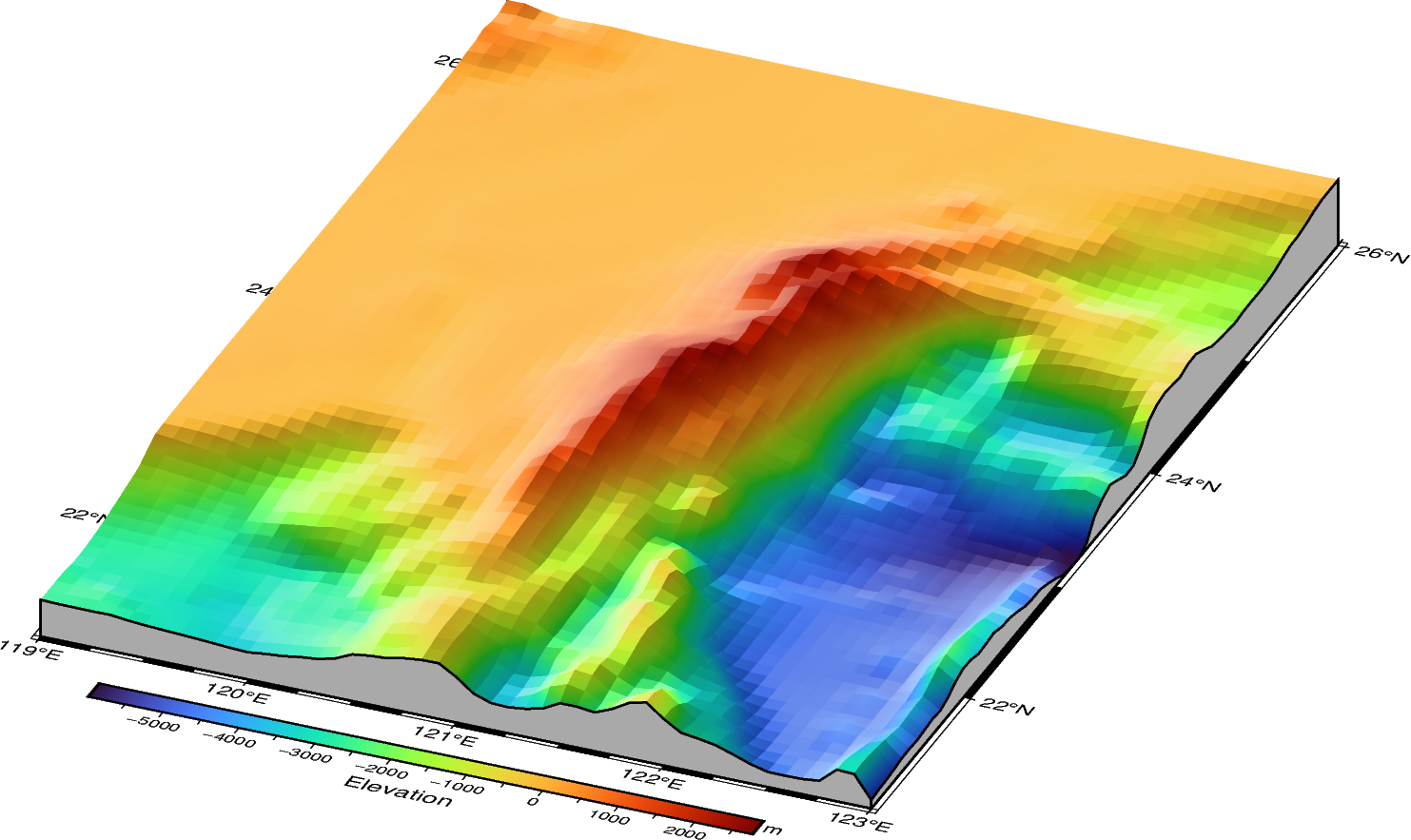
In the first step, we create a 3-D topographic map using pygmt.Figure.grdview.
We use a region around Taiwan to demonstrate adding features on a 3-D surface.
# Define the study area in degrees East or North
region_2d = [119, 123, 21, 26]  # [lon_min, lon_max, lat_min, lat_max]

# Download elevation grid for the study region with a resolution of 5 arc-minutes.
# 5m provides clearer terrain than 10m while still being reasonably fast.
grd_relief = pygmt.datasets.load_earth_relief(resolution="05m", region=region_2d)

# Determine the 3-D region from the minimum and maximum values of the relief grid
region_3d = [*region_2d, grd_relief.min().to_numpy(), grd_relief.max().to_numpy()]

# Set up a colormap for topography and bathymetry
pygmt.makecpt(cmap="gmt/globe", series=[-6000, 3000])

fig = pygmt.Figure()

# Create a 3-D surface
fig.grdview(
    projection="M12c",  # Mercator projection with a width of 12 cm
    region=region_3d,
    grid=grd_relief,
    cmap=True,
    surftype="surface",
    shading="+a0/270+ne0.6",
    perspective=[157.5, 30],  # Azimuth and elevation for the 3-D plot
    zsize="1.5c",
    facade_fill="darkgray",
    frame=["xaf", "yaf", "WSnE"],
)

# Add a colorbar
fig.colorbar(perspective=True, annot=1000, tick=500, label="Elevation", unit="m")

fig.show()
grdblend [NOTICE]: Remote data courtesy of GMT data server oceania [http://oceania.generic-mapping-tools.org]
grdblend [NOTICE]: SRTM15 Earth Relief v2.7 at 05x05 arc minutes reduced by Gaussian Cartesian filtering (26.2 km fullwidth) [Tozer et al., 2019].
grdblend [NOTICE]:   -> Download 180x180 degree grid tile (earth_relief_05m_g): S90E000
2. Adding coastlines on a 3-D surface
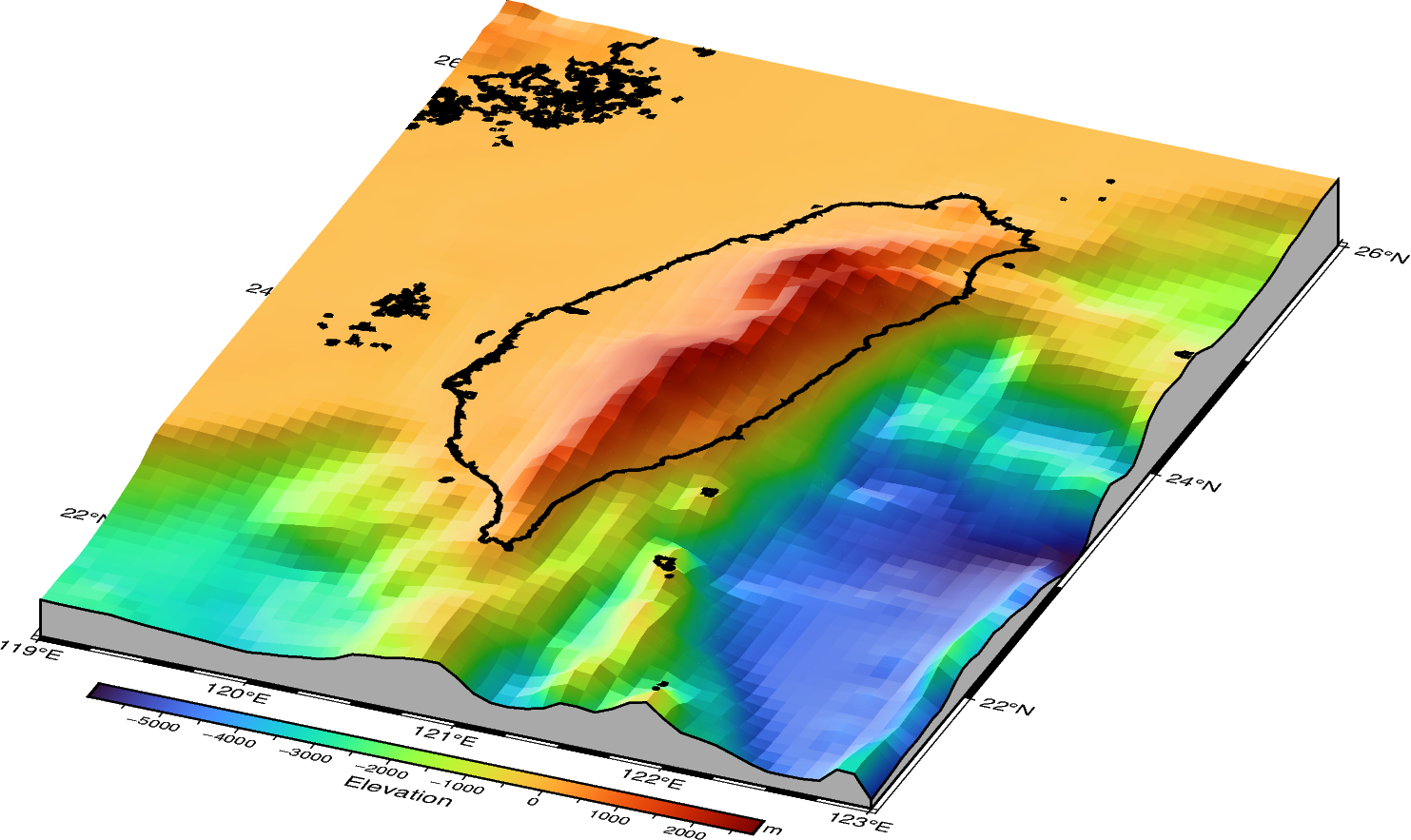
Next, we add coastlines using pygmt.Figure.coast with a matching
perspective setting. Here we set the z-level to 0 so coastlines are drawn
at sea level.
3. Adding symbols on a 3-D surface
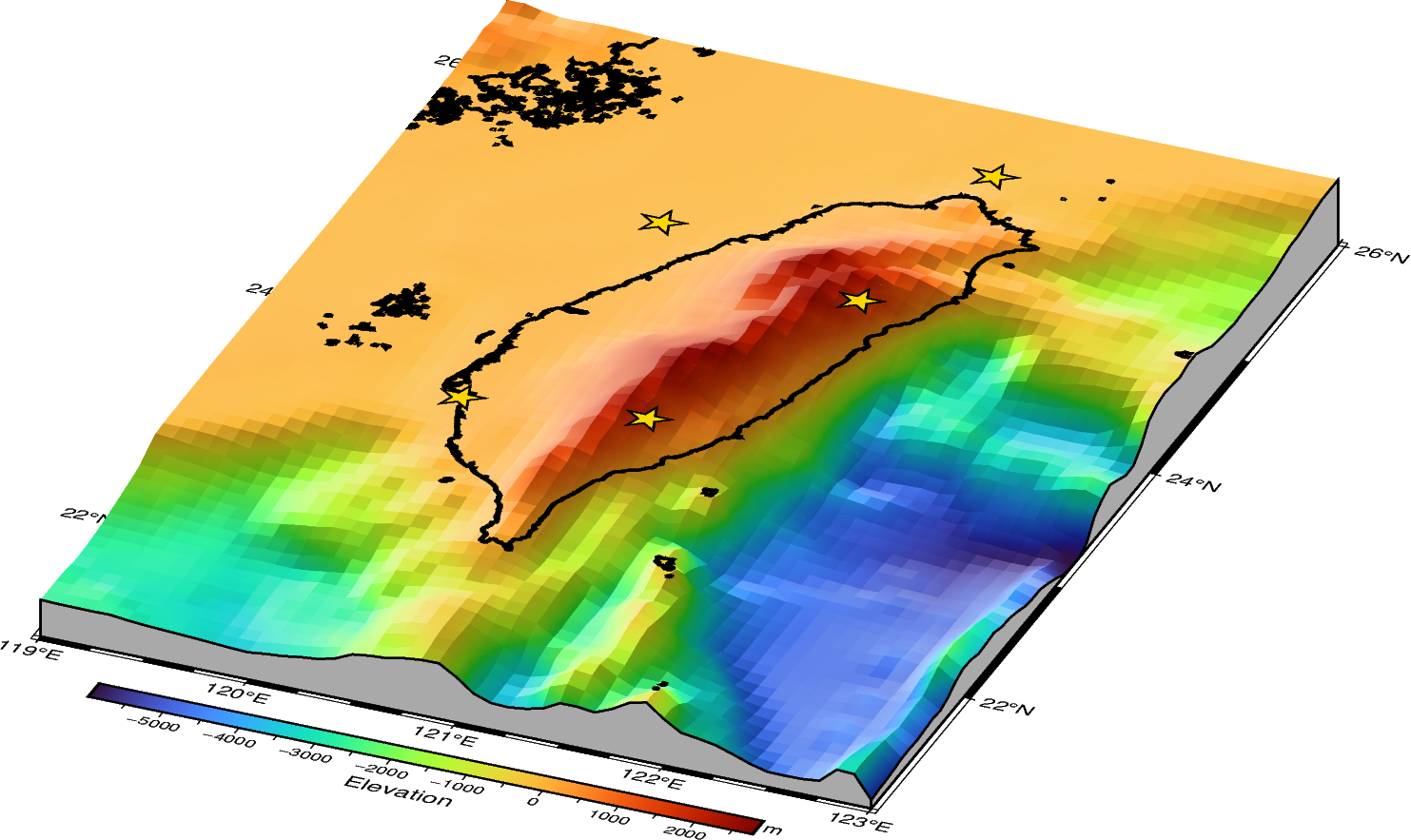
In the third step, we add star symbols on top of the same 3-D map. To plot
symbols on a 3-D surface, use pygmt.Figure.plot3d. The z-coordinate should be
set to a value at or above the maximum elevation to ensure the symbols are visible.
Note that 3-D rendering in GMT/PyGMT uses a painter’s algorithm (depth sorting)
rather than true 3-D occlusion. From some viewpoints, symbols that should be
hidden behind terrain may still appear visible.
# Sample point data: five coastal cities around Taiwan
cities = pd.DataFrame(
    {
        "longitude": [
            121.74,
            121.61,
            121.14,
            120.30,
            120.53,
        ],  # Keelung, Hualien, Taitung, Kaohsiung, Taichung Port
        "latitude": [25.13, 23.99, 22.76, 22.63, 24.27],
        "name": ["Keelung", "Hualien", "Taitung", "Kaohsiung", "Taichung Port"],
    }
)

# Use one common z-level so all stars share the same shape and size.
max_elevation = float(grd_relief.max().to_numpy())
z_stars = [max_elevation + 1500] * len(cities.index)

# Add five identical star symbols on top of the 3-D surface
fig.plot3d(
    x=cities.longitude,
    y=cities.latitude,
    z=z_stars,
    style="a0.65c",
    fill="gold",
    pen="0.8p,black",
    perspective=True,
    zsize="1.5c",  # Use the same zsize as grdview
    no_clip=True,
)

fig.show()
4. Adding text annotations on a 3-D surface
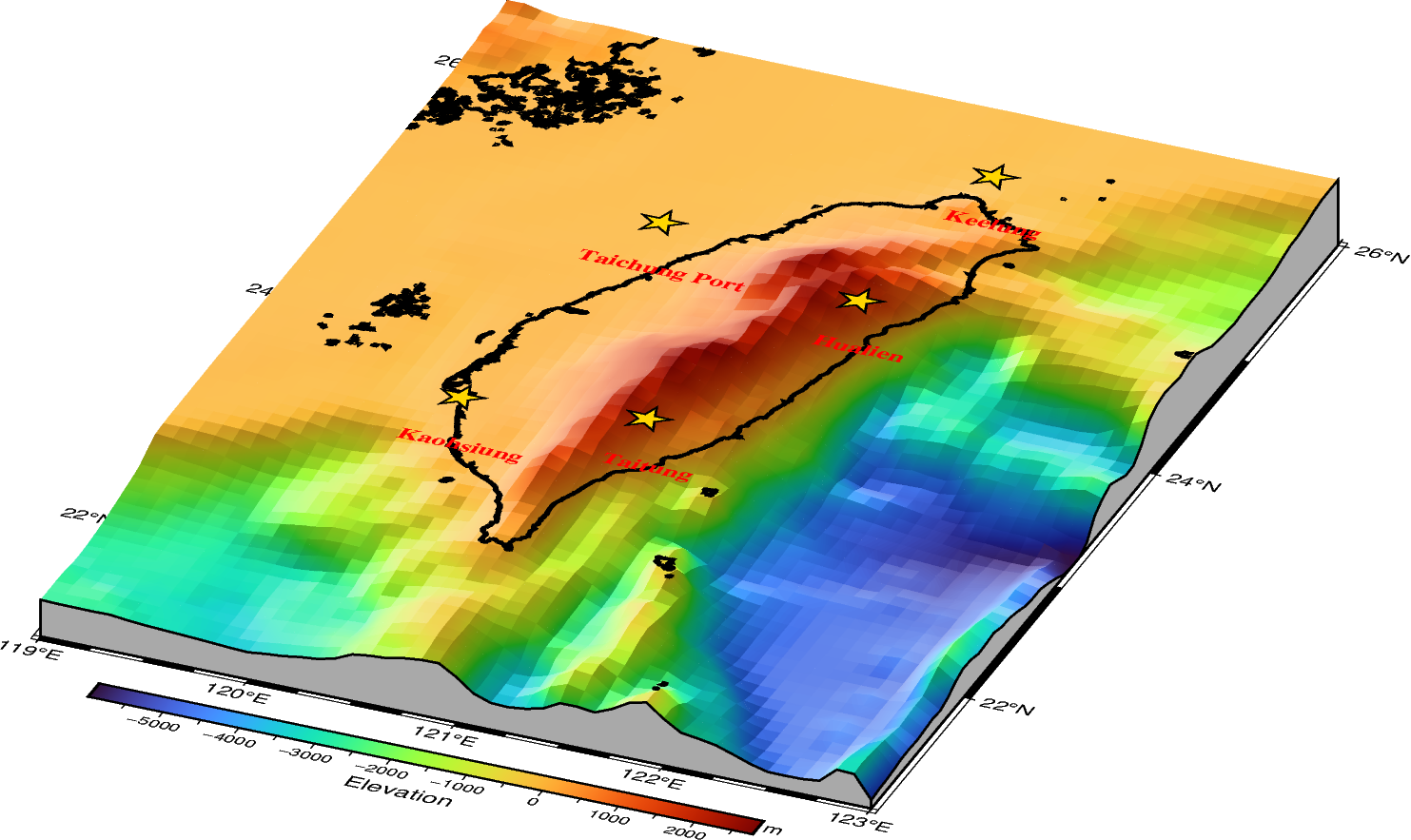
In the final step, we add text labels to the same 3-D map. To add text
annotations on a 3-D surface, use pygmt.Figure.text with
perspective=True. Note that the current implementation of text does not
support a z parameter for controlling the vertical position of text labels.
The text will be placed at the base of the 3-D plot (z=0).
# Add text labels for cities
# Note: text is placed at z=0 (base level) since z parameter is not yet supported
fig.text(
    x=cities.longitude,
    y=cities.latitude,
    text=cities.name,
    perspective=True,
    font="11p,Times-Bold,red",
    no_clip=True,  # Prevent text from being clipped at the frame boundaries
)

fig.show()
Total running time of the script: (0 minutes 6.587 seconds)